Powerful coverage
Large, long-range fogging effect with low noise output.
Sterilisation fogging — space and surface treatment for environments where cleaning alone is not enough.
The traditional approach to controlling contamination has been to implement cleaning and disinfection regimes. This targeted approach may be sufficient to maintain day-to-day control of contamination, but it does not necessarily eliminate all environmental micro-organisms — and in some instances they can persist in factories for several years.
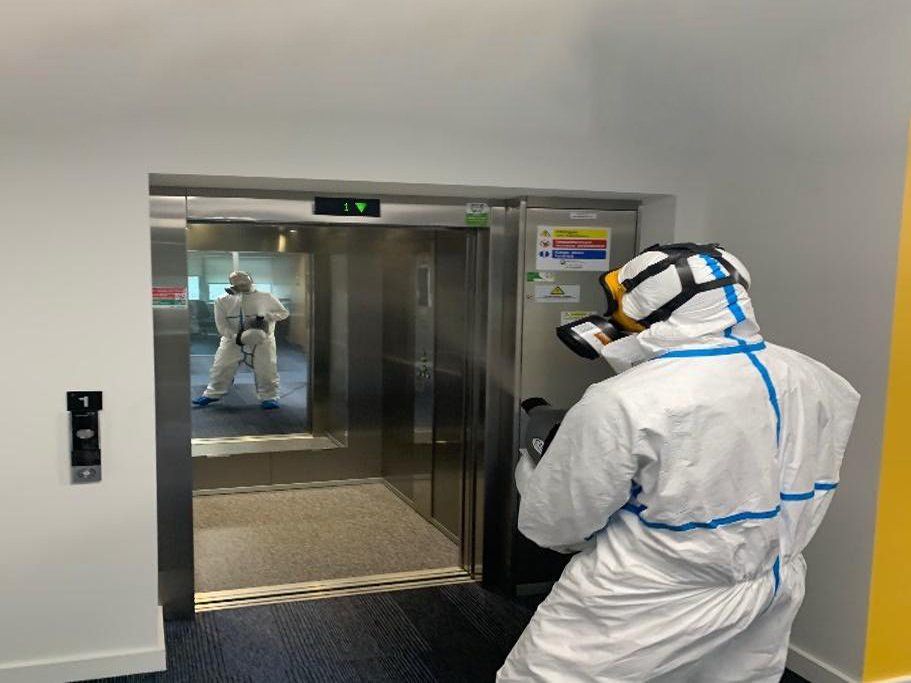
Bio-fogging is a sterilisation technique that creates a dry or wet mist which eliminates a high percentage of, if not all, pathogens that cannot be reached by conventional cleaning. It is a long established and recognised method of sterilising an entire surface area, including walls, ceilings, furnishing, carpets and floors. The methods involved in the bio-fogging process have been used and developed over a number of years.
The answer is very much dependent on the liquid used within the machine. SteriZar will not cause damage to any surrounding surfaces, be it hard surface or soft furnishings.
Some fogging products contain hydrogen peroxide as a sanitising agent, which can have a pH level of between 2–3 (acidic) and have been known to have a serious detrimental effect on both soft furnishings and the general fabric of the building. SteriZar, with a pH level of between 7–8 (rainwater), can therefore be used in all environments without removing furnishings, or having to seal vents to prevent a toxic formulation transgressing into other areas of the building.
Bio-fogging is an extremely effective sterilisation method. Biocides are used in the process and it has been proven to work effectively against viruses, fungi, spores and bacteria such as Influenza, MRSA, C. difficile and Norovirus.
The biocides we use conform to the EU Standards Biocide Directive.
Dry foggers (thermal foggers) produce small droplets that will remain airborne for a period of time and carry into nearly all of the airspace in any given area. Cold fog will also penetrate airspaces without remaining in the air for such a long period of time, and with some machines the droplets can be produced in sufficient numbers to create a wetting effect on surfaces.
The process works by filling a room with a fine mist that can vary from 5–50 micron particles (1 micron = 1 millionth of a metre, or 1 thousandth of a millimetre). These particles, being so small, remain suspended in the air long enough to kill some of the airborne viral or bacterial contamination. As they settle onto all surfaces — even the ones never touched by conventional cleaning — the biocide continues to kill any surface contamination and, more importantly, prevents any future cross contamination.
Within the SteriZar formulation are positively charged ions that give the product the ability to adhere to any surface that the particles come into contact with, be it the underside of furniture, walls or ceilings.
Using the variable control nozzle on the fogging machine, complete control of particle size and output is easily applied depending on the area and type of sanitisation required.
Large, long-range fogging effect with low noise output.
3.5 litre liquid capacity in a machine a technician can carry through a site.
Suits large-scale spraying operations and specialist sanitisation of isolated areas alike.
A compact, efficient and effective cold fogger.
We can advise on whether fogging is appropriate and schedule a treatment around your production.